Most people who know me well know that I am a night owl. I have trouble falling asleep before midnight, even when I have to get up at 5 the next morning to get to the airport.
I won't try to explain why I prefer to stay up late, but I would like to take some time to talk about the night, and the night sky.
I started thinking about this subject on a plane trip, coming home to Albuquerque from a family visit in New York City. It was close to midnight on New Year's Eve, and outside the sky was dark. The ground, however, was lit up everywhere you looked. Even the least populated areas had lights glittering somewhere, from roads or cars, or the houses that dotted the landscape.
We had just taken off from the Washington-Dulles airport, and were still fairly close to the ground, when I noticed the lights that lit up the roads below us reflected as a soft glow from the road itself. But the lights themselves were pinpricks of light, meaning they were also shining directly up into the sky!
This light, besides being completely wasted, doesn't just shoot off harmlessly into space. Just as our atmosphere scatters sunlight during the day, turning the whole sky a bright blue, it also scatters artificial light, and enough of it can cause "skyglow," blocking the light from stars and the Milky Way, and turning a gorgeous night sky into a bland grey wash.
Tuesday, January 3, 2012

Thursday, December 22, 2011
"Only a Theory," and My Favorite Debunked Idea
If I had a nickel for every time I heard the phrase "only a theory..." well, I suppose I'd be on my way to having a good collection of nickels. I might even have enough for a cup of coffee. Am I right?
(The above is one of the many downsides to always wanting to be technically correct, but I'm going to get back on track now.)
"Only a theory" is pretty much the same as saying "only everything we know." A theory, despite the colloquial definition, is not just some idea you had lying awake at night. Theories are amassed from vast amounts of information, all pieced together into one model that explains everything. And I mean everything.
If you look at the theory of gravity, or universal gravitation, the reason it was so amazing was that it connected the rules governing objects falling toward the Earth, and the rules governing the orbits of planets around the sun. Nobody before Newton had ever connected those two phenomena, but many had tried to explain one or the other separately. The problem was, without looking at the whole picture, a satisfactory answer was impossible.
So, let's be clear right now. In scientific terms, a theory is a model that explains all the information we have, but is impossible to directly observe. A hypothesis is an untested idea that, through research or experimentation, could be proved, disproved, or become a theory of its own (if it fits all the data yet is impossible to directly observe). A hypothesis that does not fit the data is discarded, and a hypothesis that fits some of the data, but not all of it, is probably waiting for a better one to come around.


(The above is one of the many downsides to always wanting to be technically correct, but I'm going to get back on track now.)
"Only a theory" is pretty much the same as saying "only everything we know." A theory, despite the colloquial definition, is not just some idea you had lying awake at night. Theories are amassed from vast amounts of information, all pieced together into one model that explains everything. And I mean everything.
If you look at the theory of gravity, or universal gravitation, the reason it was so amazing was that it connected the rules governing objects falling toward the Earth, and the rules governing the orbits of planets around the sun. Nobody before Newton had ever connected those two phenomena, but many had tried to explain one or the other separately. The problem was, without looking at the whole picture, a satisfactory answer was impossible.
So, let's be clear right now. In scientific terms, a theory is a model that explains all the information we have, but is impossible to directly observe. A hypothesis is an untested idea that, through research or experimentation, could be proved, disproved, or become a theory of its own (if it fits all the data yet is impossible to directly observe). A hypothesis that does not fit the data is discarded, and a hypothesis that fits some of the data, but not all of it, is probably waiting for a better one to come around.
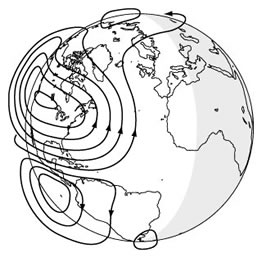
A current model of atmospheric electric currents.

An outdated model of atmospheric electric currents.
Tuesday, December 6, 2011
Extra-solar planets and you
I love that I live in this age of planet discovery. In 1992, the first planet (or dwarf planet, minor planet, or Trans-Neptunian Object) in Pluto's neighborhood (besides Pluto itself, discovered in 1930) was discovered, and since then there are now more than 1200 on record, including Eris, Makemake, Haumea, Sedna, Orcus, and Quaoar.

Love those names.
Outside our solar system, planets are being discovered at record speeds by the orbiting Kepler telescope, which is watching about 150,000 stars and waiting for the amount of light they give off to dip. The dip could be for a variety of reasons, but if it dips again, there might be a planet passing by in its orbit. And if the light dips again, after the same amount of time has passed, you've found a planet for sure. And if you know how big and bright the star is (which you can determine from its light spectra), you know how much light the planet is blocking, and therefore how big it is.
Some of the first planets discovered outside our solar system were discovered with similar techniques. Watch a star, see if it dims, and see if it dims with regularity. The other method involved careful measurements of the stars position, and seeing if it moved side to side with regularity. That would indicate a planet's pull on its star, tugging it around as it orbits. Both methods began rudimentarily, only detecting the biggest gas giants orbiting closer to their suns than Mercury to ours. These are commonly known as "sun-grazers." And when you're looking for Earth-like planets, you have to keep looking.
This is all prelude to the big news. So far, Kepler (the satellite, not the long-dead astronomer) has discovered 708 confirmed planets (at least three passes) and over 2,000 planet candidates (only two passes so far). These results were announced yesterday, and one of those 708 confirmed planets had some interesting features...
Monday, December 5, 2011
A Personal Update and a Holiday Science Book List
It's 10:47 AM, Monday, December 5th, and I'm sitting in my apartment in Albuquerque, New Mexico as a bitterly cold wind gusts dusty snow everywhere outside. I have the day off today, but my wife is at work, and my Internet connection is acting dodgy at best. I have my coffee, but my usual distractions are failing me right now. It appears the universe is telling me it's time to update.
For the past couple months, I've been settling into a new routine of waking up late, going to work late, and coming home late. My current job is the least enjoyable I've ever had, and I don't mind saying so, as I'll probably be leaving it soon. In fact, I think I used to have nightmares about needing to take a job at a call center, and here I am. (I was told it would be mainly email correspondence, which I think I would have enjoyed if it had turned out to be true.)
Thursday, November 10, 2011
The Leafcutters

Every time I tell someone about leafcutters, I have a captive audience. I don't even need the pictures to showcase these amazing animals' talents. I'd read about them when I was young, but didn't truly appreciate what they do until much later, probably around the time I was in college.
I got to see them in person for only the second time in my life a few months ago, during a trip to Costa Rica. The first was on a trip to Brazil with my family when I was thirteen. I didn't even think to take pictures then. This time I knew better.
These leafcutters had a nest within a five minute walk of the hotel where my wife and I stayed, near some houses and open land. I can't imagine the locals having any problems with the ants; a leafcutter ant in your house is lost.
So, what makes leafcutters so special? I can sum it up in two words: they farm.
Monday, November 7, 2011
How We Know: The Periodic Table of Elements

As anyone who has been through high school chemistry should know, the "periodic table" is that not-quite-rectangular chart covered in letters and numbers that symbolize every type of atom we know about. Some of you may have had to memorize it. My school provided it for every test where we might need it, which was essentially cheating, since the periodic table itself is just a big cheat sheet that provides a wealth of information if you know how to look for it.
First of all, remember that the table isn't just the elements in numerical order arranged in a strict grid. It has towers on the left and right sides, and entire extra rows sandwiched in between some elements near the bottom. These were not arbitrary decisions. By laying out the table this way, many elements that have similar properties are grouped together, so you know where to look for the noble gasses, for instance, or the alkali metals.
But I don't want to get too much into how we use the periodic table today. I want to give you two dates, and you'll see the question I'd like to answer. First, the periodic table as we know it was developed by Dmitri Mendeleev in 1869. The scanning tunneling microscope, an instrument capable of viewing individual atoms, was first developed in 1981, over 100 years later. Additionally, when Mendeleev developed his table, only 63 of the 118 elements we know of today were known, and yet, his table did not have to be drastically altered to accommodate the new arrivals as they came. In some instances, the table actually predicted elements that had yet to be discovered.

Making history doesn't always look like much.
So, how on earth could Mendeleev and other scientists possibly know what they were looking at on the atomic level, in order to produce a chart organizing the elements by such properties as the relative weight of an individual atom?
Tuesday, November 1, 2011
Allow me to draw you in... to the new host of Handsome Science!
Hello, Readers!
Welcome to handsomescienceblog.blogspot.com, the new location for all your good-looking science needs! I dropped Tumblr simply because I don't know nearly enough of the html coding language to modify my page to my liking, and what I want Handsome Science to be wasn't quite possible with any of the templates I'd found.
Blogger, run by Google, on the other hand, is extremely customizable, even for someone with zero coding ability. Essentially, if you can create a Word document, you can set up a blogspot blog.
(Blog blog blog. There, now that word has temporarily lost all meaning for me.)
So, about my hiatus. I'm afraid I haven't been able to buckle down and write much since gaining gainful employment. I will try to get up early enough to write, but I think I will stick to a more reasonable goal of two or three posts a week instead of five. My brain has a silly tendency to give up if I can't reach a goal instead of doing my best and falling a bit short. So I'll set a more reasonable goal and see how that goes.
There was another problem I experienced two weeks ago, a kind of hurdle I set up that I just couldn't jump over. I was working on "How We Know: The Periodic Table," but I couldn't for the life of me find any online resources that explained how John Dalton came up with the first atomic masses. I could have guessed, but that's not what we do here. So I'll set that aside in favor of something I can talk about:
Tractor beams!
Welcome to handsomescienceblog.blogspot.com, the new location for all your good-looking science needs! I dropped Tumblr simply because I don't know nearly enough of the html coding language to modify my page to my liking, and what I want Handsome Science to be wasn't quite possible with any of the templates I'd found.
Blogger, run by Google, on the other hand, is extremely customizable, even for someone with zero coding ability. Essentially, if you can create a Word document, you can set up a blogspot blog.
(Blog blog blog. There, now that word has temporarily lost all meaning for me.)
So, about my hiatus. I'm afraid I haven't been able to buckle down and write much since gaining gainful employment. I will try to get up early enough to write, but I think I will stick to a more reasonable goal of two or three posts a week instead of five. My brain has a silly tendency to give up if I can't reach a goal instead of doing my best and falling a bit short. So I'll set a more reasonable goal and see how that goes.
There was another problem I experienced two weeks ago, a kind of hurdle I set up that I just couldn't jump over. I was working on "How We Know: The Periodic Table," but I couldn't for the life of me find any online resources that explained how John Dalton came up with the first atomic masses. I could have guessed, but that's not what we do here. So I'll set that aside in favor of something I can talk about:
Tractor beams!
Subscribe to:
Posts (Atom)